
Mastering Mindfulness: Supporting Positive Coping

Mindfulness.jpg

“I want to turn off my mind, catch my breath, feel less tension, sleep better.” The techniques of relaxation and mindfulness have been around for centuries, both in definition and in practice in various cultures. For some, the process of mindfulness describes being aware of your surroundings and slowing down your mind to remain in the present moment. For others, it has become a vital coping skill for anxiety or distress to allow grounding, emotion regulation, focus, and a sense of calm in otherwise difficult situations. So how does one present the ideas of grounding, mindfulness, or relaxation to clients in meeting their individual needs?


Explore the History

For many, the concept of feeling relaxed or calm is experienced rarely due to elevated anxiety or trauma triggers in everyday life. Perhaps you start a session with exploring the times they’ve felt more at peace or relaxed. Even if it were years in the past, this exercise can provide helpful insight into situations or context that allow your client small shifts or temporary relief from discomfort or anxiety.  Questions that might help you explore this with your client include:

  • Can you remember a time when you felt calm and relaxed? Can you tell me more about it?
  • How does it feel in your body to experience calm or relaxation? What sensations do you experience?
  • What has helped you before in feeling calm or relaxed? What makes that different now?


Become Body Aware

Exploring the history of times a client has felt calm or relaxed is but one piece of the puzzle. Depending on the client’s background, trauma history, or the impact fight/flight/freeze reactions, their body may have adapted to the increased stress and cortisol levels in interesting ways.  Some clients will express increased anxiety or panic in response to relaxation, as it feels vulnerable or uncomfortable in their current, adapted state of functioning.  For others, a numbness may exist where they cannot feel their body with possible contributing factors including depression, hypoarousal/freeze response, or desire to maintain self-preservation. Lastly, clients may easily drop into intellectual conversation about their symptoms but avoid experiencing any sensation in their body due to anticipated discomfort or negative arousal.

Keeping client limitations and comfort in mind, it can be helpful to encourage clients to gently become more aware of their body through various therapeutic activities. It is suggested to start with neutral areas of the body and move quickly from one area to another to prevent exacerbation of sensation that would prevent progress or cause a client to retreat from noticing their body out of fear or discomfort. By engaging them in the following activities, you can support a client in building body awareness and distress tolerance in ways that feel safe.

  • Body scan-start at your feet and notice any sensations as you move gently upward to your calves, thighs, hips, waist, etc.
  • Concentrated body scan-have the client identify neutral or safe areas that aren’t associated with negative sensation like hands, knees or feet.  Have them focus on one area in detail, asking questions about temperature, sensation when touched, and encouraging the client to engage in use of textures and varying touch to explore sensation.
  • Colored Glasses-our new favorite intervention from Dr. Dan Siegel in his book Mindsight, obtain or create colored lens glasses for clients to explore varying perspective of objects around them, insight into sensation in low-risk ways, and connection to memory that all support the practice of mindfulness.


Use all Five Senses

All of the above exercises support experiential learning in session. Another favorite tool that can support a client who experiences any negative sensation or experiences hyperarousal or flooding during a therapeutic exercise is to move their attention outside of themselves and into the room as a grounding technique. To do this, you can ask the client to become more aware of the chair underneath them or their feet on their floor.  A few of our favorite tools are listed below that can be helpful in engaging a client outside of their own body.

  • 5-4-3-2-1: What are five things in the room that are blue? Four things you can touch? Three things you can hear? Two things you can smell? One thing you can taste?
  • Four Elements by Elan Shapiro: 1) Earth/Grounding: what do you see/hear/smell, 2) Air: Take measured breaths, inhale for four counts, exhale for four counts, 3) Water: Take a drink of water, use gum/mints or think of your favorite food to generate saliva, which serves as a calming agent to activate the parasympathetic nervous system and relaxation response, 4) Fire/Light: think of a place real or imagined that makes you feel calm or safe. Can you describe it using your five senses?
  • 5 Minute Mindfulness: have the client pick an object to focus on, either in their hands or within sight. Gently direct them to notice all qualities of the object including temperature, texture, color, height, etc. for five minutes duration.


Modeling of Mindfulness

In addition to the mindfulness exercises listed above, it can also be helpful to create a coping kit of objects that can be engaging and cater to all five senses for client use within your office. Many therapists utilize objects such as essential oils, lotion, touchstones, magnets, putty, carved wooden objects, fur, water, and sand to engage clients in mindful practice. As your client discovers which objects are effective for them to practice mindfulness, you may encourage them to purchase and utilize these objects outside of session as well.

Regardless of which tools or techniques you elect to use in support of your clients, it can be even more helpful to notice your own body and energy in the room. By becoming aware of your breath, posture, and energy levels, you can support client in feeling safe or supported to do this work. By practicing alongside your clients, you model what it means to feel grounded or mindful, which is beneficial not only to your client seeking relief, but to yourself as the clinician mindfully engaging each client in their meaningful work and progress towards health.

Holding Space for Horror, Hurt, and Healing

ben-white-194220.jpg

Have you ever felt the sensation of déjà vu? The gut feeling that you’ve been here before and thus can’t escape this surreal feeling, like you’re floating, your stomach is full of rocks, and there’s a ringing in your ears? For many of us, February 14, 2018 was a day of déjà vu in its worst form, reliving the trauma and horror of another mass shooting.

For me personally, the sudden anger, sadness, grief, and avoidance that came to the surface were the very same that I experienced after the Aurora Theater Shooting on July 20, 2012.  For others, it felt like Columbine on April 20, 1999.  Many people around the world are affected by the loss and violence surrounding a mass shooting and so many of us want answers. As therapists, we hold space for the questions and the grief, providing a safe environment for processing of loss, fear, and desire to understand. As trauma therapists in particular, we encourage clients to explore fears and needs in order to feel heard, and possibly, to begin the healing process again. And yet there are days we struggle with balance, the effort of holding space for others as well as holding space for ourselves.  If we are completely honest, it may even feel easier to hold space for others rather than think and feel our own emotions.

Professionally, it didn’t occur to me that Aurora would stay with me in my practice, year after year. July 2012 was supposed to be a month of celebration as our cohort had graduated and were seeking our first jobs as therapists. We had bonded in role plays, through projects, on adventures, and with humor. Survived internships, passed exams, and grew as individuals. Aurora would prove to impact the cohort quite rapidly when we found out four of our own peers were present and involved in the violence that took place. It took all day to get answers about their safety, and when we finally did receive word, we came together to grieve the loss of one of our own and trauma to three others. You may know him as the hero who took a bullet for the woman he loved, shielding her from the chaos in the theater. His actions show his character and the person he was in this world. There is so much I could say, but know that he was loved by many and brought humor and lively spirit to otherwise heavy work. We grieved together over the weeks that followed, knowing the impact would go beyond our cohort and be felt around the world.  Before we could blink, the cohort was scattering rapidly, almost like a driving force was pushing us away from one another, and away from the reminders of what we’d lost. It became easier to avoid and attend to others, to embrace their pain and needs for healing by throwing ourselves into the therapeutic work, perhaps hoping to heal ourselves in the process.

And yet with each new tragedy, full of images, horror, and tears, we are transported back to our own dark times. Perhaps triggered to the point of needing breaks, tracking our own emotions, and holding boundaries with our clients to stay present in their grief. Grappling with whether to share our pain with clients out of connection and compassion or decide to lock it away for another, more private time.

Whatever direction you decide in your own grief, know that your efforts to help others through connection and compassion go a long way in recovering from these tragedies. Let us be gentle with ourselves as we are with our clients. Let us acknowledge the hurt and remain open to the healing. Let us recognize the avoidance of pain and the safety needed to face it. And let us hold space when words cannot capture what is felt rather than said.  Only when being true to ourselves and embracing vulnerability can we truly support healing.

In loving memory of Alexander C. Teves

Love Languages: Empty or Full?

lovelanguages.jpg

Gary Chapman starts his book The 5 Love Languages, by sharing his concept of love being measured like a gas tank and asking: are we empty or full? This imagery can be pretty powerful in measuring affection, value, and connection to others in our life, not only with spouses or partners, but by family and close friends as well.


Languages Defined

Supporting your client with knowledge of the 5 languages can be supportive of self-awareness as well as provide some guidance in how they can potentially strengthen their relationships. You may start by inviting your client to define each of the 5 languages and provide real-life examples that are meaningful to them. You may also provide support in identifying which languages are most important to your client by what they report lacking or voicing in moments of unhappiness. The 5 languages in summary according to Gary Chapman are 1) Physical Touch, 2) Quality Time 3) Words of Affirmation, 4) Acts of Service and 5) Gifts. Below are some examples of what might be expressed within each language type:

  • Physical Touch - hugging, holding hands, kissing, sex, rubbing someone’s back, sitting close, casual touch
  • Quality Time - talking a walk, eating dinner together, lying in bed, taking a drive, engaging in a shared hobby
  • Words of Affirmation - expressing compliments or appreciation through words, such as “I love you, I’m proud of you, I appreciate you, you make my life better”
  • Acts of Service - washing their car, cooking their favorite meal, picking up the laundry, doing an extra chore
  • Gifts - making them a card, buying their favorite food, flowers, chocolate, or trinket because it reminded you of them

Please be aware this is not an exhaustive list in that there are many more examples that a client can identify based on their own experience. Also keep in mind that there are some rules around the languages in how they are expressed.


Food for Thought

With The 5 Love Languages come some rules of how they are expressed to be appropriately categorized and recognized as your own. Quality Time for example, defines one-on-one time that promotes connection and conversation. Many couples or families would say they spend plenty of time together in activities such as going to the movies, reading, driving, or watching TV. As you can already guess, these activities do not encourage connection but only proximity in being in the same space at the same time. For Acts of Service, one should keep in mind that the act performed is done authentically and without agenda. For example, one may wash their partners car or run an errand to make their partner’s day easier or bring them joy, not expecting a favor in return. This rule also applies to Gifts in the idea that we aren’t giving someone we love a gift in the hopes that they will return the favor or owe us something in return.


Discovery and Depth

Gary Chapman provides great examples of Love Languages in action in his book. For many, reflecting on what they ask for or ask more of, can be helpful in discovering their top Love Languages. The book has a quiz in the back to encourage reflection and one can also access the quiz online for free to determine top Love Languages at http://www.5lovelanguages.com/profile/.

So where do we go from here with a client? Once aware of one’s own languages, you can support your client in exploring their partners or loved ones. For many of us, we express the languages that we prefer or languages that make us feel loved, which may not translate well to our partners or loved ones in meeting their needs. If there is an overlap of the top two languages for a duo, their communication can occur relatively naturally due to speaking the same language on most occasions. If a duo does not have a language in common, it can require extra effort to connect and speak the language that supports your loved one in feeling appreciated and ‘full.’


Handing out Homework

This may all resonate with your client on paper, but the real connection between the concepts and experience comes through practice! Assigning low-risk homework of practicing a loved one’s desired love languages can provide your client with evidence of the value of connecting with others in this way. For one client attempting to reconnect with her spouse, she saw a softening and leaning in from her partner when she engaged in their chosen language in authentic ways after weeks of conflict. Actions speak louder than words, which can absolutely apply in helping your client connect with loved ones and also advocate for their own needs in relationships.

In a time when love is sought, defined, and desired, having something concrete for clients to work on can be both empowering and reassuring to their experience in relationships with loved ones. The 5 Love Languages speaks to a desire to connect with others and develop a sense of belonging, best captured in this popular quote by Susan Sarandon in the movie Shall We Dance.

“[In a relationship] you’re promising to care about everything. The good things, the bad things, the mundane things, all of it, all the time, everyday. You’re saying ‘your life will not go unnoticed because I will notice it. Your life will not go unwitnessed because I will be your witness.’”

Happy Connecting!

Community Confidentiality: Supporting Collaboration with Consent

confidentialcommunity.jpg

“I cannot confirm or deny.” How do you maintain confidentiality for your client? It may seem easy enough when there is a clearly written, signed release or when your client refuses a release, thus declining collaboration at this time. However, what does it look like in the following situations?

  • Your client is involved in an open Child Abuse and Neglect case.
  • An attorney calls you saying they represent your client and would like copies of your client record for a disability claim.
  • An insurance company calls to report the client listed you as a provider and they want to know your diagnosis to award the client a life insurance policy.
  • You outreach an organization about who they serve. They respond by wanting to obtain additional information from you on the client you want to refer.
  • A referral source wants to know if their client called to set up an intake and begin services with you.
  • A community resource shares that your client scheduled an appointment with them for next week.
  • A foster parent wants to know why the parent isn’t engaging in services to reunify with their child.
  • A CASA volunteer wants to know if the family is working on their fighting in your sessions because they believe it would be helpful.
  • The spouse of your client calls asking you how sessions are going.
  • Your client acknowledges that their friend is also your client.
  • Their probation officer includes you in a group text or email to schedule a meeting on behalf of the client with several parties you don’t know.

These are just a few of what could be dozens of examples of sticky situations when it comes to maintaining your client’s right to privacy. Let us look at possible responses to the above scenarios to determine what could be best. And as always, seek consultation, supervision, or legal advice if you have needs or concerns.


Signed Release

When a third party reaches out to you by email, text, or voicemail, it can be helpful to notify your client and obtain a release in the next scheduled session. Notifying your client of the outreach you received can support trust and transparency in the therapeutic relationship. It can also help facilitate a discussion on the importance of getting a client’s written permission to respond to an inquiry on their behalf, whether it’s an insurance company, secondary referral, family member, or community partner.


Legal Requirements

Perhaps your client is involved in an open Abuse and Neglect case, diversion, or probation. These entities have been assigned to your client as part of a larger treatment plan to address a legal concern. Whether your client is mandated to complete therapy or the third party referred directly to you, there is a different level of confidentiality implied due to the collaboration needed from you to provide progress reports and updates as appropriate around your client’s engagement in services. If you client is resistant to signing a release, helping them identify the specific pieces of information to share—and thus restricting some information in the effort of privacy—can be helpful to the client’s anxiety about personal information that is disclosed to others. When submitting a progress report to DHS or probation for example, providing your client with a copy can also demonstrate a sign of transparency and trust in encouraging them to review it and provide feedback on their level of comfort with the material shared.


Sense of Urgency

The desired scenario is one of those mentioned above, where we have the client complete a signed release of information highlighting exactly what is released and for what purpose. However, there are times that a sense of urgency may arise in getting permission quickly to collaborate with a community partner in a timely fashion. Depending on the frequency of client contact including regularly scheduled appointments, you may need to get email or verbal permission over the phone from your client as a temporary measure in obtaining consent prior to a written release. Standard practice is to have permission in writing so email can feel slightly more comfortable than verbal permission to us as providers. Either way, documenting your client’s permission with intention to get a full release in the immediate future can be helpful in allowing collaboration and sharing of information under a time restriction.


Curbing Curiosity

Collaboration is a helpful component of therapy, within reason, to support and validate client efforts. It may become apparent that there are other parties involved who may want updates on your client’s progress. This could include caseworkers, probation, child advocates, other mental health providers, foster parents and more. Where it can feel confusing is when third parties know you are actively working with the client and make assumptions that you can share information in the spirit of collaboration. For example, the foster parent is wanting to know how the parent, your client, is doing in services in order to encourage their child of the parent’s hard work. The inquiry may feel innocent enough, however the foster parent is not your client, and is therefore not privy to this information without your client’s consent. Something as innocent as attendance or participation in services can be reported back to other parties and could result in information being misconstrued or shared without permission.


Encompassing Electronics

In an effort to not have information shared unintentionally with third parties, being mindful of how your electronic correspondence is recorded can be helpful. Being aware of emails with additional recipients or group text messages requesting scheduling of a team meeting can feel nebulous regarding confidentiality. Documenting your effort to send correspondence only to approved parties identified on a signed release supports your client’s wishes as well as ethics compliance. Providing disclaimers in your electronic signature in email composed on your computer or phone can also support limiting liability if information is sent to the wrong recipient or forwarded to a third party outside of your control.


Limiting Liability

Documenting each of your efforts to maintain confidentiality as a standard of your practice can limit liability. Obtaining regular releases yearly from your client can keep their record up to date. Utilizing encrypted email and electronic health records for client progress notes can restrict situations where their information could be compromised. When it comes to confidentiality in direct interaction with third parties, identifying a statement of “I cannot confirm or deny they are my client” can feel unhelpful, restrictive but necessary in not admitting unapproved information to family, friends, referral sources, or legal representatives without permission. This feels most challenging by phone when even acknowledging your need to obtain a release is admission of your client’s connection to you. For many, having to share that a release has been revoked can feel even more challenging. You may say something like “permissions have been revoked and we suggest you contact the person of interest directly” can provide enough information for them to understand you won’t be interacting with them further and prevents direct identification of your client by name or circumstance.

Communication with community partners is an intricate dance that can feel challenging when caught off guard by emails, texts, or phone calls asking for updates on your client’s work. Demonstrating your ethical capacity in delaying disclosure of information until a release is obtained can indicate your professionalism in the community and willingness to collaborate under the appropriate circumstance. Be sure to follow up with the community partner once a release is signed to further demonstrate your willingness to collaborate together. Lastly, thinking about the possibly scenarios that put privacy at risk and obtaining signed releases upon introduction to the client can streamline this process by simply asking who else is involved in their treatment or care. Having a scripted response ahead of time for situations where a release is not yet completed can support you in making the best decision to support client confidentiality and community engagement with consent.

Clinical Writing: Consistency and Confidentiality

ClinicalWriting.jpg

A question heard frequently in private practice is how do we stay on top of paperwork when our passion is engaging the client in doing meaningful work? What if clinical documentation supports them in getting additional resources such as disability or explores reunification with their children? When working with individuals or families involved in the Department of Human Services (DHS), probation, diversion, or other entities evaluating your client, the documentation you keep takes on an additional level of importance in capturing the client’s progress. So how does one balance recording the content of the session consistently while protecting client confidentiality? Balancing requirements for documentation with client privacy is an art form that requires consistency and practice.


Construction of Case Notes

Depending on your preference for hand written, typed, or electronic notes, your content and formatting of those notes could be dictated by private or state assistance insurance panels in order to process claims and receive payment for services rendered. With this in mind, most insurance panels require the following to be identified in each note:

  • Full name of client and insurance ID
  • Date of service
  • Time of Service
  • Duration of Service
  • CPT Code that indicates individual therapy, family therapy, case management, etc.
  • Overview of therapeutic interventions utilized in the session
  • Progress towards identified treatment goals
  • Current mental health diagnosis
  • Client presentation in session
  • Next scheduled appointment

By formatting your notes in a similar fashion, you can streamline any documentation needs from secondary parties desiring collaboration. Don’t forget a signed Release of Information from your client to facilitate collaboration!


Consistency in Content

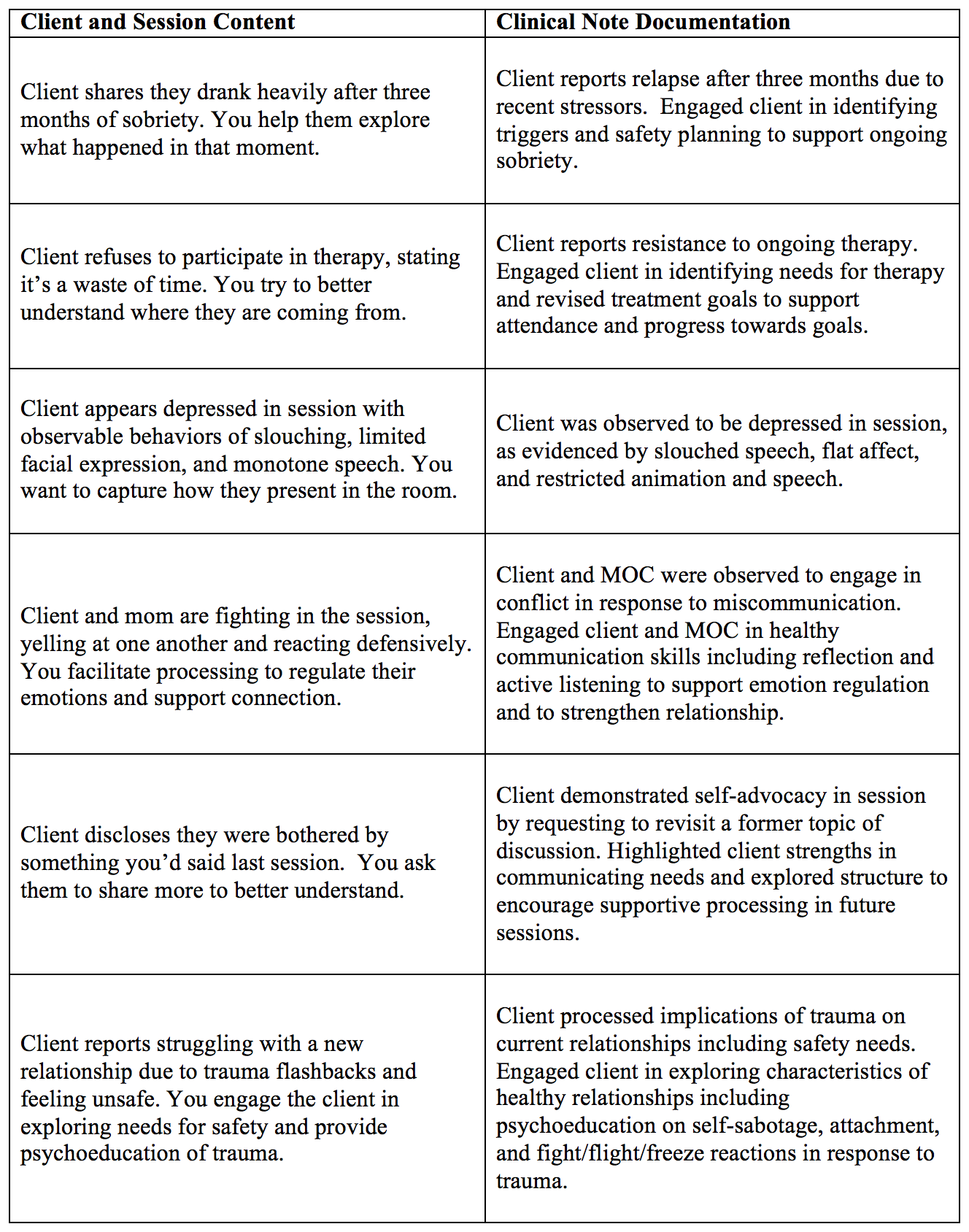
Formatting not only provides the outline of a universal progress note, it can support consistency that will reduce the time spent on notes each week. Many therapists report frustration that their notes are behind schedule due to wanting to dedicate their time and energy to the client work. By utilizing a template for notes, it will become easier and more efficient to complete notes in a timely manner, especially in utilizing clinical language. When struggling with how to write clinical language that captures the professional interventions present in each session, it can be helpful to have some go-to phrases that indicate progress without providing too much detail. Here are some examples of common content and professional language that could be helpful in writing clinical notes:

Content Table


Confidentiality for Clients

In addition to clinical documentation supporting professional record keeping in line with ethical requirements, another component it can support is client confidentiality. It can feel like a fine line providing adequate written evidence of professional interventions without violating client privacy.

One strategy to ask yourself is, “would my client feel uncomfortable with my notes being seen in court or by others?” If the answer is yes, you may want to re-evaluate how you write your notes to support clear, concise interventions that would not put confidentiality at risk. Below are some documentation tips to consider in supporting client privacy:

  • Keep client direct quotes to a minimum.  They are best included when capturing safety concerns. Client reported “I want to die” leading to assessment and safety planning in session.
  • Avoid emotion-driven language without evidence such as, client was happy/sad/angry in session.
  • Support ownership of statements such as, this writer observed or client reports when documenting statements or content of a session.
  • Keep language neutral. It is best to avoid a positive or negative tone in notes to prevent accusations of bias or alignment that would put professionalism in question.

It is recommended you seek consultation or supervision to further explore your documentation needs. Your professional organizations can provide ethical guidelines whereas insurance panel websites offer Providers valuable templates for clinical documentation that meet audit standards. With luck, you will perfect your clinical writing to maximize time in therapeutic interventions while remaining compliant with documentation needs to best serve your clients and your practice.

Streamlining Your Business Process: 7 Tips for Private Practice

streamline.jpg

A new year has begun! For many mental health professionals, we are resuming our schedules after holiday travel and hoping to start the year off right! What are your goals for the year? Perhaps you want to streamline your paperwork process to maximize time with clients? Or maybe you want to explore a billing support business to stay on top of your insurance claims and expenses? Perhaps you want to transition to only taking private-pay clients so you aren’t required to identify a diagnosis and can work with clients from a different lens? So how do we stay on top of our thriving practice addressing client needs and interventions while still remaining compliant with the more mundane and time-consuming processes of paperwork and billing?  Below are some tips and tricks to consider in maintaining a balance of both organization and time management!


Tip #1: Go Paperless

In today’s day and age, technology continues to enhance our processes of organization and time management. Consider going paperless with your client note system to complete paperwork in less time. Companies like SimplePractice, TherapyPartner, and TherapyNotes offer encrypted, protected and thus confidential note systems that can support your client files electronically as well as connect clients to appointment reminder texts and emails and offer billing services to streamline claims submissions and payment.


Tip #2: Set a Schedule

When trying to balance your time with clients and stay on top of paperwork demands, it can help to set a schedule.  Setting aside some time daily or weekly to submit your billing not only helps you complete it when the content is fresh in your mind and getting paid in a timely manner, but can assist you with leaving work truly at work, representing a transition ritual from work to home.


Tip #3: Use a List

This may seem strange when we’ve just discussed the benefit of going paperless bur having a to-do list where items can be crossed off when completed can be very satisfying. Consider using a planner or notebook that’s with you at all times. For others, consider using your to-do list in your phone where you can set reminders and due dates for completion. In our busy world, it can be hard to keep track of everything so a list that’s accessible from anywhere at any time can help record thoughts and ideas that come up in our daily living.


Tip #4: Creating Connections

Staying on top of trainings, webinars, books and other materials can help you streamline your niche and business practices. There any many great materials out there but we especially love Simon Sinek’s Start with Why in discovering what drives us as helping professionals and business owners. Joining an online community for mental health professionals can also be helpful in asking in-the-moment questions about business practices.  We suggest checking out The Private Practice Startup and Building Brilliance as two online communities that offer tips, tricks, and offer access to a community of like-minded individuals.


Tip #5: Have a Business Plan

Working as hard as you do, it helps to have a business plan to create a sense of direction. Is your goal to have 20 clients per week consistently? Do you want to expand to include other insurance panels to serve more clients? Perhaps you want to identify a stream of secondary income? By creating and reviewing your business plan on a regular basis, you can check in on both short and long-term goals of being your own business. Templates for creating a business plan can be found online.


Tip #6: Have an Accountability Buddy

Even with a business plan, life can sometimes get in the way of tracking where we are headed. Combine that with how private practice can feel isolating at times and we can find ourselves procrastinating or drowning in the details. Connecting with a colleague and identifying one another as our accountability buddy can help hold us to our goals as well as remain connected within our community. Engaging your accountability buddy can help inspire your process, define your goals, brainstorm strategies to achieve those goals, and celebrate your successes along the way.


Tip #7: Take Time Off

Being a business owner can take a lot of our time and energy. Don’t forget to take time off to prevent burnout and allow creativity to flow from s different headspace in another environment. We know that being our own business means we can potentially work 24/7 not only in serving clients but the behind-the-scenes responsibilities. Time off can support us in being grounded, compassionate clinicians as well as focused, driven business owners who can enjoy the results of our hard work and remain inspired to continue to serve the populations we value most.

Therapeutic Goal Setting: Measurable Motivation

goals.jpg

As December comes to a close, your clients could be looking to the new year to create resolution or revisit their treatment goals in the hope of change. It’s a time to explore goals that are measurable and attainable; it’s a time to create small steps to build self-confidence so they remain motivated and hopeful. Perhaps your client comes into your office saying “I want to join a gym to help my depression.” You meet their disclosure with compassion and curiosity and ask them to share more. You learn they want to work out every day to help their mood but aren’t currently working out on a consistent basis, and not ever at a gym. So you find it important to explore with them their motivation as well as the perceived strengths and challenges of reaching their goal. Your client learns that smaller steps can support success and agrees to working on short-term goals to build confidence and to move towards their long-term goal of working out daily.


Monitoring Motivation

Why is it important to explore motivation around a goal? Research tells us goals around fitness and gym attendance peak in January and dramatically decline by February and March every year. Additional research tells us that we must do something consistently for a minimum of 30 days for it to become a habit. What this conveys to us as human beings is that we need to see results or progress to continue to work hard at a goal. You may normalize this for your client. You may also provide psychoeducation on the Stages of Change from Motivational Interviewing as a visual to support your client in identifying strengths and barriers to change. In meeting your client where they are at, consider the questions below to explore motivation with your client:

  • What do you want to change? (Precontemplation to Contemplation)
  • What makes that a problem for you? (Contemplation)
  • Is it a big enough problem to want something different? (Contemplation)
  • How would you achieve the desired change? (Preparation)
  • What do you need to support change? (Preparation)
  • What would help you to begin? (Action)
  • How will you know when you are ready for change? (Action)
  • What would help you keep going? (Maintenance)
  • Who/What would hold you accountable?
  • What would happen if you don’t succeed?

By engaging your client in exploring these questions, they can identify any current strengths or barriers to succeeding and further explore what is needed to progress through the stages of change.


Make it Measurable

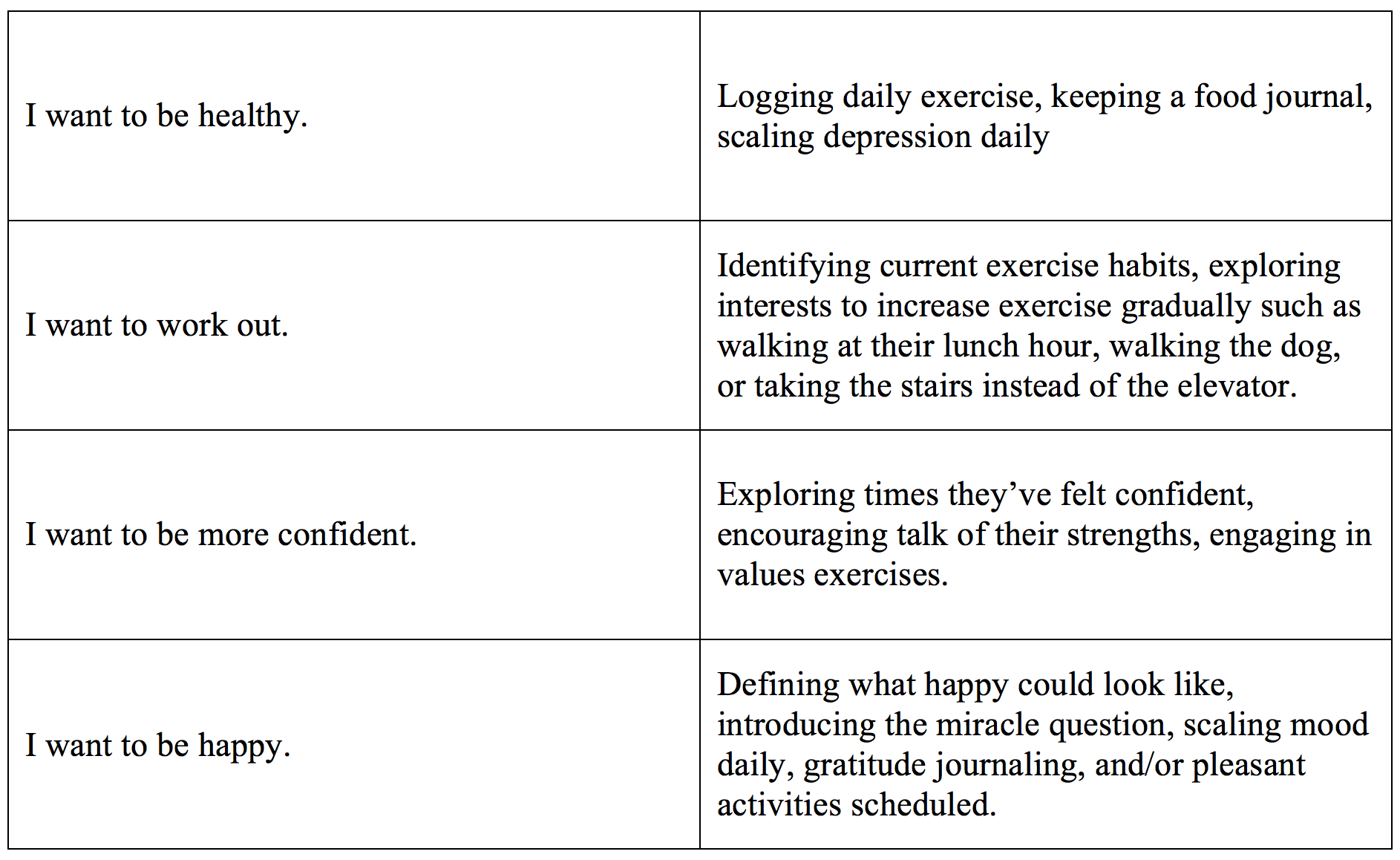
It isn’t uncommon for a client to identify a goal but not know how to attain it, thus remaining in the stage of contemplation. It becomes our responsibility as their support to break down a long-term or larger goal into measurable, smaller pieces. Here are some examples of how to make it measurable when a client identifies a larger, more abstract goal in therapy:

Chart

Our therapeutic interventions can support short-term goals blending into long-term goals over time. By identifying and writing treatment goals that are measurable and can be reviewed with your client regularly, the effort it takes to achieve these goals can feel validated and attainable for your client.


Supporting Strengths

Validation can be a strong motivator. Helping clients slow down to identify their strengths throughout the process can be motivating in and of itself. It isn’t surprising that clients can find themselves stuck in the past, such as awareness of how they used to be able to achieve goals with no effort and frustration that they cannot find that same success today. Or perhaps they are so future focused they aren’t able to recognize the smaller changes that have taken place. One of the most rewarding elements of therapy can be reviewing goals and progress towards those goals. Your clients may be unable to recognize the small but important shifts in their functioning and therefore it can be impactful to help them remember where they started in this process and how their hard work is supporting healthy change. By identifying their strengths and supporting them throughout the process, clients can experience motivation and recognize goal progression, allowing the ongoing growth and change they seek.

Change will not come if we wait for some other person or some other time. We are the ones we’ve been waiting for. We are the change that we seek.” Barack Obama.

Avoidance and Attendance: How to Address Each in Therapy

attendance.jpg

It’s that time of year. The time where certain clients disengage from therapy in response to the season, holidays, or stress, and the time when others need appointments the most in order to support them through trauma, family conflict, isolation, and loneliness. When working for an agency, the crises seemed to intensify during the holidays. First it was the client diagnosed with Bipolar Disorder experiencing depression symptoms due to the winter weather. Then the client with trauma from sexual assault having to see their perpetrator at the family holiday dinner. Or the single client with no access to family experiencing increased suicidal ideation in response to spending the holidays alone. Or the client with high anxiety becoming stressed about money and gifts for their family, losing sleep and snapping at their kids. And finally, the client sober from alcohol for three months having to navigate holiday parties around family and friends where temptation may lead to relapse. Combine these factors with a client’s distress tolerance and they could engage in therapy fully to receive support, or in some cases, disengage in response to their symptoms. As helping professionals, how do we balance the variety of client needs with consistency, empathy, and grace?


Lack of physical attendance

The more easily measured is a change in physical attendance in your scheduled sessions. Perhaps the client starts to cancel sessions when they’ve been consistent in attending each week in the past. How do you explore their needs when you haven’t been able to see them in the office for several weeks now? Depending on how they are engaging you to cancel the appointments, you may offer a couple of ideas in response to their distress:

  • Completing a phone call to gauge what is going on in their world and attempting to re-engage them in sessions to support symptom management.
  • Offering a phone session rather than a face-to-face to explore and address present stressors if they are unable to attend.
  • Identifying a different appointment time that allows physical attendance such as an early morning or later evening if appropriate.
  • Redirecting text messages of distress by offering an appointment to discuss and support them.
  • Reviewing their attendance contract with them to determine how they’d like to proceed, including possibly placing scheduled appointments on hold and resuming at a later time if appropriate.


Lack of emotional attendance

The hope is that with ongoing rapport, the conversations above can demonstrate healthy communication, accountability, and boundaries with a client experiencing increased distress. Rapport becomes even more important when engaging a client around a lack of emotional attendance or participation in session. Perhaps you begin to notice that the client arrives late every week, jumping into sessions with surface-level details or changing subjects rapidly throughout the scheduled time. Or maybe they remain at head-level in their processing, not dropping down into emotions and deeper meaning in session with you. With healthy rapport, you as their support can gently name the behaviors you are seeing in the room to encourage a healthy conversation about their avoidance. Here are some examples of how you might approach them in a compassionate way:

  • In response to their running late: “I’m noticing how rushed it feels lately coming into our sessions and feeling like we have to fit it all in. Can you tell me more about what that’s like for you?”
  • In response to staying in their head: “I’m noticing you are very much in your head today when it comes to describing how you feel, can I ask you to pause a moment and share with me what’s happening in your body right now?”
  • To encourage reflection: “I feel like you are very far away in this session even though we are sitting across from one another, what does it feel like for you?”
  • To encourage feedback: “I’m hearing that you have a lot on your plate right now. What can I do to help you best in this moment?”

Any of these gentle inquiries can lead to a tenderness and connection to emotion as well as an access point for clients to identify and explore their needs. These sessions can prove to be some of the most impactful and fruitful in not only holding space for emotion and modeling what it looks like to communicate needs, but also supporting vulnerability and self-advocacy in the client as to how they can engage their supports.


I hear you

As a therapeutic support, engaging clients from a place of compassion and empathy can be powerful to their experience. Balancing a neutral curiosity with ongoing optimism that, together we can find relief, can be empowering for the client. By starting with gentle reflection and gaining better understanding of their emotional response to stressors in their life, we can then encourage exploration and practice of positive coping. Whether it be concrete tools for coping or holding space for their emotions, we are creating a safety net to address any fear, guilt, or shame they may be harboring around their functioning in these moments of distress. Like any roadmap, with direction and insight, we can address avoidance and attendance from an authentic, supportive place to best help our clients in navigating their world.

“If we can share our story with someone who responds with empathy and understanding, shame can’t survive.” Brene Brown in Daring Greatly: How the Courage to be Vulnerable Transforms the Way We Live, Love, Parent, and Lead.

Family Functioning: Low Risk Activities to Improve Relationships

LowRisk.jpg

I don’t need therapy, they are the one with the problem! How does talking about it fix things between us? This will just make the fighting worse! You are meeting with a family in your office for the second time. This family is composed of a parent, grandparent, and two preteens and everyone appears on edge. You track body language and energy in the room as you begin to explore what family therapy means to each of them. You notice the crossed arms of the preteens, the angry face of the parent, and the withdrawn quality of the grandparent sitting farthest away in the room. How do you respond? What will engage each of them in this process of healing to strengthen their relationships?


Set Boundaries

When first engaging a family, it can be extremely important to set boundaries as their family therapist so you can begin to engage the family system as a whole. Identifying your role clearly, including your ‘no secrets’ policy, can be helpful for each family member to hear that you aren’t picking sides or aligning in a way that prevents cooperation from all members. Not holding secrets and describing your efforts to remain appropriately transparent with the family can convey neutrality and respect, two elements that can increase willingness to participate and rapport building in your relationship. Reviewing limits of confidentiality can also set the family system up for success in being aware of how you must respond to conflict and needs for safety.


Explore Goals

In conjunction with setting healthy boundaries, engaging each family member in exploring their goals for family therapy can increase their motivation and commitment to the work. What would the preteens like to be different? What would make things better in their home? What would the parent like to see in regards to structure of house rules and parenting? How would the grandparent like things to be between their loved ones? Once you gather information from each family member, you can support the family in identifying how these goals can be measured over time to support positive shifts within their relationships and home.


Slow Down

Positive shifts in functioning are the ideal outcome of therapy and it’s possible that the family is engaging in therapy with a sense of urgency to “fix” their problems. Some members in the family can present with a sense of demand to jump in, unpack the conflict, and tackle change in rapid fashion. However, if the therapist moves too quickly, they run the risk of other family members becoming flooded, feeling attacked, or disengaging due to the pressure they feel by other members of the family or by the pace of the process. Here are some examples of what you might notice if things are moving too fast:

  • One or more family members gets quiet and refuses to participate
  • Body language conveys discomfort such as crossed arms, slouched posture, clutching a pillow to their chest, or avoidant eye contact
  • Responding with “I don’t know” when questions are asked
  • Increased agitation including rapid speech, flushed skin, facial grimacing, and fidgeting
  • Leaving the room or pulling out their cell phone

Noticing these cues can be important in acknowledging a client’s discomfort and attempting to re-engage them in ways that feel safe. Validating emotion is a powerful tool in family therapy and can ensure everyone has an equal voice in the process.


Structure Sessions

Being mindful of how you engage the family each session in pursuit of their goals can encourage structure, support, and full participation. You may need to explain to one member of the family that jumping right into conflict could deter other members from participating in the future. Addressing immediate concerns with a safety plan can acknowledge the need for structure and safety while still engaging all family members in exploration of coping skills and needs for support.


Creating Commitment

While the safety plan and goals are being established, further rapport and exploration of family functioning can occur through low-risk activities. Low-risk activities, by definition, are presented as and appear to clients as activities that feel safe and don’t require intense participation. Due to the fact that each family member has a different level of comfort in the room, low-risk therapeutic activities can be a great way to explore their communication and build positive experiences between family members to further encourage participation in the therapeutic process.

Some examples of low risk therapeutic activities:

  1. Feelings Jenga or Uno with each color or block representing a) things we like, b) things we don’t like, c) things we appreciate about our family, d) things we wish for
  2. Feelings chip toss game or bingo to explore emotional vocabulary and awareness including sharing of times they felt that emotion
  3. Feelings charades to reach emotions and body language in each family member
  4. Cooperative play board games
  5. Blindfolded obstacle course, drawing or Lego exercises
  6. Recipe for success with colored sand, containers, and cooperation
  7. The Ungame
  8. Family portrait or family tree art
  9. Family playlist with songs representing their experiences
  10. And many more

It is important that family therapists consider participating fully in the activities with the family to demonstrate equality, approachability, and cooperation. Many families enjoy the idea of seeing their therapist as a person with their own thoughts and feelings, and engagement in these activities can help a family feel connected. It is, however, encouraged that the family therapist only discloses and engages in activities that support healthy boundaries, and to further evaluate if self-disclosure is relevant and appropriate for their clients.

Introducing creative, low-risk activities can support positive experiences as the foundation for which improvement and repair in the family system can be built. Many activities can encourage new perspective and shifts in thinking by highlighting areas for growth and processing change throughout the activity. Therefore, it is encouraged that we continue to recognize the approachability of therapeutic games and activities in the therapeutic relationship not only as motivators for ongoing participation but insights into the family system as a whole.

Engaging Teens: Staying Current in their World

RapportTeens.jpg

Teenagers may be reluctant to engage in therapy due to stigma, stereotype, or pressure from their parents or guardians to “get it together,” stop a behavior, or cope with the stressors of their lives. Regardless of why they come into your office, you can support them in ways that allow them to feel safe enough to access emotion and engage fully in their own therapeutic process. Many teens have engaged in therapy in the past and few have positive things to say about their experience. A valuable question to ask in building rapport could be, “what did you absolutely not like in therapy before? Anything you want to make sure I don’t repeat?” This engages the teen to speak plainly about what their needs are in the therapeutic relationship as well as feel heard by you in asking their preferences, a client-centered approach that assures them of their active participation in the therapy process.


“I’m not your _______.”

Helping a teenager feel heard is one of many valuable tips in building rapport. Another element at intake to consider is your role in their process. It is important to establish healthy boundaries and clarify your role with teens prior to engaging them in ongoing work. Your explanation may go something like this: “I am your therapist which means I’m here to support you. I’m not your parent, teacher, friend, or probation officer as you may have those in your life already. My job is to be someone you can talk to who is non-judgmental and supports you in finding solutions to things that are stressful in your life right now. How does that sound?” By naming your role and asking for feedback, you are establishing both a professional connection and expectations of your work together from a place of respect and unconditional positive regard.


Keeping Secrets

Privacy is important to teens as they build their identities, form new relationships, and begin to seek autonomy in their world. Exploring the limits of confidentiality is vital to supporting them in their process in that they seek clarify of what truly is confidential and what is not. Many teens may be aware of your role to keep them safe if they were to disclose suicidal thoughts or threaten to harm someone else. But do they know you are a mandatory reporter who is required to report any abuse? Do they understand you may monitor the age of their sexual partners to make sure they are of legal age to consent? Do they know what self-harm looks like in working with you? Do they understand the implications of experimenting with drugs and alcohol and how you many need to respond if they are driving under the influence or violating probation? Having conversations about these limits can support a teen in knowing what is truly private and can allow them to more fully be themselves in your office in having a clear understanding of the consequences.


Recipe for Success

Now that you’ve gotten the formalities out of the way, what are some ideas for how you can connect with a teen? It is recommended you start by getting to know their interests, friends, and goals. One favorite rapport building intervention is having a teen build a playlist of their life, identifying songs that represent them and their experiences. They can discuss the songs in detail, allowing the therapist to build rapport and gain insight into their life. My personal favorite exercise is a ‘recipe for success’ that involves colored sand art and a teen’s ability to identify what they need to be successful in their life such as love, independence, time with friends, etc. They build a recipe of these elements as they converse with you and the art serves as both a low-risk therapeutic activity and a symbolic reminder of their success that they get to take home.

Below are other therapeutic intervention ideas that could be considered when working with a teen to build rapport:

  • Life mapping their interests and relationships
  • Vision boarding their wants, needs, and goals
  • Self-portrait in paint, clay, pencil, etc.
  • Family tree or genogram


Remaining ‘In the Know’

Teens will be the first to give you feedback on how they think therapy is going, but only if you encourage them to have a voice. Once way to do this is to support them in speaking how they wish to, whether it be slang, cursing, or other modern expressions of communication. Encouraging a teen client from the beginning to speak as they would outside of your office can support them bringing their shields down to fully participate. You may want to make sure they understand all ways of speaking are permitted as long as they are respectful to both themselves and you in the room. In response, many teens will express relief in being able to be themselves.

By encouraging teens to speak in ways that feel right to them, you should also be prepared to be honest and open about slang or colloquialisms that you may not have heard before. This demonstration of vulnerability by the therapist can actually support the client in feeling empowered and serve as evening the status quo between therapist and client in the therapeutic relationship. This vulnerability also allows humor, another great tool with teens.


Media Influence

One final tool that can increase your success in engaging teens in therapy is remaining aware of the events of their world. Many teens are following popular social media stories, YouTube videos, celebrities, and TV shows that can serve as connections or analogies for concepts you want to explore in therapy. For example, a teen who is reporting difficulty making friends may resonate with the main character from The Edge of Seventeen, a movie that can speak to your teen in identifying similar stressors they could report they are experiencing. By remaining aware of pop culture references, you can engage a teen in comparisons that truly resonate with them, encouraging self-awareness and personal growth.


Tips from Teens

In review, there are many elements to keep in mind when engaging teenagers in therapy. A panel of urban teenagers here in Denver, Colorado provided meaningful feedback on how best to engage them in structured therapy. Their answers were both obvious and reassuring and I am happy to pass them on in the hopes that fellow therapists will find success in engaging teens in their therapeutic work!

Teenagers shared with professionals:

  • Don’t talk down to us
  • Don’t censor us
  • Don’t be so much older that we can’t connect with you
  • Don’t read our file and think you know us
  • Don’t say you understand what we are going through when it’s our own experience
  • Don’t label us
  • Don’t tell our secrets to others
  • Don’t be afraid of our tests to see if you are trustworthy
  • Don’t give up on us

“Some are young people who don't know who they are, what they can be or even want to be. They are afraid, but they don't know of what. They are angry, but they don't know at whom. They are rejected and they don't know why. All they want is to be somebody.” 
 Thomas S. MonsonPathways To Perfection: Discourses Of Thomas S. Monson