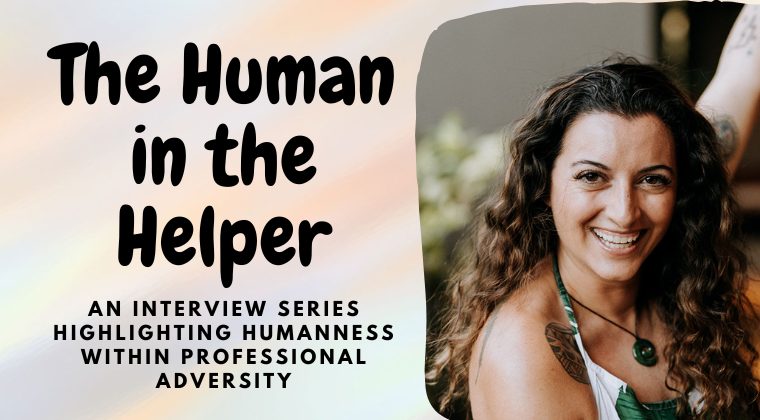

The Human in the Helper: Long COVID changed me as a person and as a therapist

Amanda likes to dance in the rain, enjoys live music, and prefers to be barefoot in the grass. With her love of dogs and nature, you might be surprised to learn she used to identify as a workaholic. “I’ve always worked two to three jobs at a time. I was in flight mode.” Amanda is describing the go-go-go of the hustle culture so many of us embraced after graduate school. “I felt like I’d been hit by a truck leaving grad school, I felt so unprepared.” Now Amanda chooses to see 3-4 clients a day in private practice to support rest and health, although the journey to this current pace of life was unexpected.


“I had a full time job, a small private practice, and was supervising a team,” Amanda shared. Then she got COVID-19 in May of 2020. “I was bedridden for the first five months of my 3.5 year healing journey.” Amanda describes being dizzy and fatigued most of the time, having to close her private practice and work her full time job from her bed. “I took calls laying down. I did supervision on the phone laying down. I did zoom meetings laying down.” Amanda could only sit up for an hour at a time and developed new symptoms every month.


“My body wasn’t strong enough to push COVID out,” Amanda says. She was forced to slow down in order to take care of her health. “Being a COVID long-hauler stopped me in my tracks and I was forced to stop abandoning myself and attune to my needs. The road to recovery has been painful and defeating. It seems like when I take two steps forward, I then take 10 steps back.” Amanda quit her full-time job and reopened her private practice, pacing herself each day to avoid a health flare-up or crippling fatigue. She describes feeling pressure in the beginning to push herself beyond her limits or risk letting others down. Then she came to realize the importance of putting the oxygen mask on herself before putting it on others. Pacing to avoid a flare-up has been a difficult journey and full of sacrifices. Flare-ups can still happen. “I still wake up sick. Sometimes it feels like dizziness, other times like the flu.”


Yet, Amanda has learned so much having long COVID and has changed aspects of her life for the better. She is grateful to have the resources and support she needed for this significant change. Many COVID long haulers and others with chronic illnesses have lost jobs, spouses, housing, etc. “Others have not been as fortunate as I have been to recover to the point of being able to start their own business. This experience has made me acutely aware of the blessings I have been given and I’m determined to never take privilege, support, resources, and my health for granted again.” She says it helped her realign her priorities to health, nature, and family. It helped her slow down and engage in “being” more than “doing”. Her clients have similar experiences to her own, where she gets to help them find balance and unsubscribe to the hustle culture as well. “Clients want to know we are human,” Amanda shared. “Notice when your body says no,” she says, “ chronic illness has been so misunderstood. It made me a lifelong advocate and cracked my world open to many things, including how our society has unchecked ableism which can cause harm.”


Being present and curious about our urges to overwork or chase a dream is something Amanda wants colleagues to think about. “Doing our own work is so important,” she says. She suggests that noticing and honoring our limits make us better, as humans and as helpers. “Long COVID changed me as a person and has made me a better therapist,” Amanda disclosed. She has also benefited from doing her own work in therapy. She reflects that she may even been more emotionally healthy now as a COVID long-hauler than when she was a workaholic, which says a lot about how workaholism can cause harm. Amanda encourages colleagues to slow down and be present. “You’ll be a better therapist for it.”


Things happen to us as humans, even as we support our clients as professional helpers. Do you have a story you want to share the mental health community? Email us at croswaitecounselingpllc@gmail.com to learn more about the Human in the Helper Series!

Four Problems of Financial Gatekeeping

What is Financial Gatekeeping and what are the problems it brings to relationships? We first defined Financial Gatekeeping in June 2023 as “preventing a partner from having an active role in shared finances.” Financial Gatekeeping holds some similarities to Maternal Gatekeeping in that it feels one-sided, signifies one partner’s decision-making role, and has a negative impact on the other partner or the family system. Instead of mom’s refusal to allow dad to participate in caregiving or activities with their child, we want to explore the experience of refusing to allow a partner to participate in household finances. Let’s take a look at the problems Financial Gatekeeping can cause:


1.     It disempowers one partner

This challenge of Financial Gatekeeping probably feels pretty straightforward in that decision making resides with only one partner. This could look like one partner being solely responsible for the finances, such as having access to bank accounts or reconciling the family expenses each month. This could also mean that the one partner with access to finances makes all purchase decisions big or small, or is responsible for paying the bills for the family. Although there may be an initial agreement to have one person responsible for the finances in thinking it makes things “easier” on the family or couple, it prevents the second partner from having any autonomy or decision making for purchases they may find valuable or in alignment with the family’s goals.


2.     It prevents collaboration on shared financial goals

Shared financial goals are an important part of being a couple who has a healthy relationship with money, according to colleague and fellow Financial Therapist Nathan Astle. So how can we support shared financial goals? Financial Gatekeeping prevents goals from being formed because one person makes the decisions, possibly with minimal or zero input from their partner. That second partner may feel they don’t get a say, based on power dynamics, not contributing income to the household, or having a partner who makes more income than them, which can falsely serve as a justification for one person to continue making the decisions and setting the financial goals.


3.     It can lead to Financial Abuse

If one person continues to exert power over the other, this looks and sounds like Financial Abuse. Behaviors that can embody Financial Abuse include things like having one partner require permission from the other to spend, restricting their access to bank accounts or shared income tools, giving them a limited amount of money or allowance for the things they need, or requiring all purchases to go through the partner who holds all the power and control over household finances. It’s an unhealthy dynamic with increased possibility if Financial Gatekeeping is occurring in a couple or family.


4.     It reinforces negative money beliefs

For the person who is disempowered and restricted from financial decision-making, the messaging they receive from the experience of Financial Gatekeeping can reinforce their negative money beliefs. Perhaps they already have money beliefs like:


I’m bad with money

I can’t be trusted with money

I make poor decisions with money

I spend too much money


Having a partner or spouse enforce Financial Gatekeeping can then amplify these negative beliefs about ourselves, making it that much harder to have a healthy relationship with money.


If you feel like you are stuck in a pattern of Financial Gatekeeping with a partner, the good news is that things can change for the better. Perhaps you start with your own money healing to explore any anxiety or beliefs that could be driving your behaviors. Maybe you engage in couples work around money to increase your connection and communication with one another. Or maybe you start with a mini money date to identify a shared goal you can work on together. Financial Gatekeeping doesn’t have to stay a part of your partnership and money, it can evolve into something empowering to both partners with some intentional work and motivation to change!

Exploring Secondary Income versus Passive Income in Private Practice

Many mental health professionals are exploring additional income streams. Whether it comes from a place of wanting more freedom, supporting burnout prevention, or a desire to have greater flexibility than seeing 20-25 client per week, diversifying income is an important consideration in a successful, balanced private practice.

So let’s talk about passive income versus secondary income. Passive income is something that once launched, makes you money without much effort. Things like:


Book sales

Digital downloads

Online courses

Digital workbooks

An App


Secondary income is a bigger bucket of possibilities, but they also take time to build, effort to maintain, and require time allotted to produce regularly, meaning a more significant shift in your client schedule to avoid feeling overextended. Things like:


Professional training and workshops

Professional speaking

Podcasting

Radio show

Online merchandise or swag*

Retreats

Hosting conferences

Group practice

Video series

Group therapy

Intensives

Supervision

Consultation

Online memberships*

Teaching/Being a Professor


*Depending on how they are built, these could become more passive


Why should we talk about both passive and secondary income streams? As someone with 16 current income streams, the differences and options within private practice matter! For colleagues who connect with me in consultation on this piece, they want to work less so they are seeking passive income streams. Which is great, I’m all about it! And perhaps they are surprised to hear that it can take 4-5 years to see the passive income really flowing well, where additional effort or time isn’t required to maintain them. So then we start to look at secondary income streams together to make a faster, satisfying shift in their money story, with momentum towards a passive income stream in the near future. The ability to bring in additional income is an important skill in business, and thus a skill to master in private practice as well.


Want to know one question (of many) that I ask colleagues in these types of consults?


What’s one pain point for your clients that you already address?


Pain point being defined as an area of hardship, difficulty, or discomfort. Seeking a solution. Is the thing you do (exercise, skill, tool, technique) replicable and scalable to a larger platform for increased reach and income? Let’s talk about it in a consultation!


Both passive and secondary income have a place in the equation of private practice success. Honestly, my favorite type of consultation these days is helping colleagues identify their interests and passions and turn them into possibilities that generate new income. What’s holding you back from dreaming about these possibilities? Maybe you have ideas but aren’t sure how to implement them. With so many colleagues creating amazing things, you are closer than ever to finding your additional income stream(s). Reach out to one of us that speaks to what you are dreaming about. Before you know it, you’ll be one of the professionals showing others that diversified income is possible and maybe even necessary to avoid burnout in our field.

10 Tips for Aspiring Authors to Finish Their Book

As I navigate publishing multiple books—I’m working on number 7!!—there have been more questions from colleagues on the whole process. Here are ten tips to help other professionals bring their books from idea to reality!  Don’t forget to check out the videos of these tips on our Aspiring Authors playlist on YouTube!


1.     Identify Your Gift

You’ve heard this idea woven in other content from me, and it still rings as true as when public speaker coach Mari Geasair first presented it! Ask yourself, “what’s the gift I’m giving?” What do you want your reader to walk away with? What idea or concept can they learn from you? What is the call to action after reading your book? What do you want them to feel?


2.     Do your Research

First, researching other books out there that are similar to yours is important. Is your idea different enough to interest your audience? Do you have a new spin on something that folks would find valuable? Second, how old are the books out there? Is the market saturated with books on your topic, which wouldn’t bode well for a successful launch? Are the books available ten or twenty years old, ensuring your content would be well received by filling in the gaps? Is there an absence of information, which would motivate you to get your book out there as soon as possible?


3.     Make an Outline

Just like in elementary school, having an outline organizes your thoughts before putting pen to paper. It can help you start to see where information would be housed in sections or chapters, creating an intentional flow to your work. Additionally, an outline is oftentimes what a publisher wants to see included in your book proposal to consider your book and a possible contract. So although an outline may feel less than exciting to complete, consider it a roadmap of what you are writing, while also helping others see where you are headed in your book journey in order for them to give you an enthusiastic yes to publishing it!


4.     Create a Ritual

A personal favorite, what rituals can you create that you associate with writing? Are you wearing a particular outfit or pair of pants? Do you write in a specific spot to help your mind drop into the task of writing? Do you treat yourself to a coffee or listen to certain music when writing? Consider all five of your senses and how they can support a ritual that gets you into the groove of writing regularly.


5.     Set Time Blocks

What amounts of time do you need to write? Do you need several hours in one chunk? Do you need more breaks, like 30 minutes on, 10 minutes off? If you don’t schedule it, it doesn’t happen, so experiment with blocking out some times that are labeled “writing” or “my book” to see how that can motivate you.


6.     Talk About Your Book

I have had such valuable conversations when talking about my books to others. Notice their responses. Listen for their questions and assumptions, which could be transformed into content within the book. Odds are that if they have a question, so would your readers. So talk about it! It will help you flush out more things to include within your pages.


7.     Interview Other People

In alignment with Tip #6, interviewing folks can bring content into focus. Are there any themes or concepts from interviews worth capturing in your writing? Is it about highlighting a person’s perspective or experience, with their consent? Maybe you are trying to explore the lived experience of others, in comparison to your own experience as the author? Either way, I recommend interviewing folks to further clarify what content belongs in your book.


8.     Tell Stories

My favorite part of writing these days is the stories. Weaving them into each chapter can build trust and connection or teach a skill. Stories can illustrate concepts you are introducing to your audience, encourage ah-has, or be a reference point for later reflection as the reader. People remember stories and they like them, so it’s worth considering how you can use story within your book.


9.     Write the Easy Parts First

Aspiring authors can get tripped up on the idea of writing their books in order. Chapter by chapter, beginning, middle, end. This can lead to writers block if you start feeling stuck on one particular section. How about writing the “easy” parts first? Or the parts that bring you joy in the moment? The parts that feel more clear or the ones that are on your mind when writing this week? By giving yourself permission to write the easy parts first, you are also giving yourself permission to write things out of order, knowing you’ll piece it back together as an additional step later.


10.  Read It Out Loud

Some of you may cringe at this idea, but I promise you it’s an important tip for authors! Not only does reading it out loud help you check for grammar, punctuation, and flow, it also helps you check out if the content sounds like you. As an author, you are your brand. By reading it out loud, you get to ensure that it sounds like you and holds the tone you want to convey, especially if your aim is a conversational instead of academic voice. A bonus? Reading it out loud prepares you for any audio book recordings you may feel compelled to complete after the book launch! Audio books remain a popular option for readers, so having the practice of reading it out loud gets you one step closer to recording.

Are you feeling ready to write your book? Check out these additional tips from our ten amazing mental health professionals turned authors from our Virtual Book Fair this month!

The Human in the Helper: This isn’t something essential oils are going to fix.

Gabrielle shows up as vibrant, friendly, and personable, which serves her well as a mental health leader and Licensed Clinical Social Worker. She’s made quite the name for herself as an entrepreneur and consultant serving therapists and professionals around burnout and burnout prevention. With her passion, beautiful tattoos, and love of Zumba, it’s hard to believe she’s already experienced significant professional burnout in her career.


“I woke up one day and hated it,” Gabrielle shared. “My clients were no longer my ideal clients. I didn’t have the boundaries I needed. I kept hearing my own voice in my head say, ‘this is how it is.” But Gabrielle found out that things could be different. She was venting about how tired she was to a colleague in another industry one day. Their response? Sell your practice. 


“I found myself fantasizing about selling, but with the number we came up with, it didn’t seem worth the work.” At least at first. Gabrielle spoke to how she’d entered the mental health industry while working three jobs, and was subscribing to the hustle and grind culture of being a Millennial. “I believed that the harder I worked, the better it would be.” Which lead to burnout. Gabrielle recalls how she worked a job where she and her colleagues were expected to work long hours, take their work computers home, and come in on Saturdays or Sundays to get caught up.


Gabrielle then moved into private practice, rapidly growing into a group practice serving a community in need. She acknowledged that she built her business fast with the same drive of previous jobs and hadn’t worked on all of her own stuff as a person and professional. “This is what business ownership is about,” she told herself when she felt it catching up to her. Then she got the call to sell her business. “I had to ask myself, what do I want my life to look like?”


Gabrielle is a trailblazer in the mental health community by challenging the assumptions that success means a full private-pay practice or group practice ownership. “I have no regrets, this is alignment with my values,” she said of selling her practice. When asked what she wants other therapists to know, she shared, “you can create your dream life! There are so many options.” She warned against comparison to colleagues or listening to the ‘shoulds.’ She named how therapists have set high expectations for themselves, saying “we didn’t talk about the risks of burnout in school.”


When reflecting on her current roles of being a business and burnout consultant, Gabrielle shared a story of how an old job asked for self-care tools to be donated to their self-care room for employees. “This isn’t something essential oils are going to fix.” We have to agree.


To learn more about Gabrielle and how she can help colleagues and professional communities heal from burnout, visit her website at https://gabriellejulianovillani.com/


Things happen to us as humans, even as we support our clients as professional helpers. Do you have a story you want to share with the mental health community? Email us at croswaitecounselingpllc@gmail.com to learn more about The Human in the Helper Series!

Five FAQs of Financial Therapy for Mental Health Professionals

Photo by Joyful on Unsplash

Whether you are considering referring a client to Financial Therapy, or want to embrace Financial Therapy into your own work as a mental health professional, here are some common questions I get as a Certified Financial Therapist-Level I and Financial Therapy Supervisor!


1.     What is Financial Therapy?

Financial Therapy serves as a bridge between mental health and financial professional services like Financial Planning, working with a Financial Advisor, investments, and accounting. The role of a Financial Therapist, courtesy of Bari Tessler, founder of Financial Therapy is to support money healing (past), money practices (present), and money maps (future). Financial therapists are comfortable exploring the impact of money on relationships, emotions tied to money, and resulting behaviors, including thoughtful work with Financial Trauma. The goal of Financial Therapy for many is to have a better or healthier relationship with their money personally and professionally.


2.     Who can be a Financial Therapist?

If pursuing certification through the Financial Therapy Association, financial planners and mental health professionals are currently the two home disciplines applicants must come from. Other trainings are made available to a larger pool of professionals, including the Financial Social Work Certification, and The Trauma of Money training.


3.     Is Financial Therapy a private pay service?

For the most part, yes clients come into Financial Therapy as private pay clients. For mental health professionals who are also Financial Therapists, if the client is in a state where the mental health professional is licensed, they could bill insurance for a mental health diagnosis related to the financial therapy work, however it’s not common.


4.     How does a Financial Therapist get clients?

Since Financial Therapy is a growing industry, many Financial Therapists list themselves in the Financial Therapy Association online directory or market their services on their own website. Networking with financial professionals in your area can support a collaborative approach for clients you want to serve. Engaging in podcast interviews or blogs written for your ideal audience can also help potential clients find you.


5.     How do I get started as a Financial Therapist?

You’ll want to select a training that works best for you. Currently, both Financial Therapy Association and Financial Social Work offer online programs for certification. Financial Therapy Clinical Institute is also offering online courses for specific aspects of Financial Therapy, including couples and money, families and money, and Financial Trauma.


We are also fans of doing your own work to understand your edges and personal money story. This can mean engaging in individual Financial Therapy as a client yourself, participating in our 6 week online Momentum and Money course for mental health professionals (and cohorts for Financial-therapists-in-training), or seeking individual or group Financial Therapy Supervision.


Croswaite Counseling, PLLC currently offers regular Momentum & Money groups, monthly Financial Therapy group supervision, and provides Financial Therapy as well as Financial Therapy individual supervision to mental health professionals wanting to heal their own money story and/or serve clients in this role. Learn more and discover the best-fit service for you at https://croswaitecounselingpllc.com/financial-therapy

Understanding Insurance Terms in Private Practice

Photo by bruce mars on Unsplash

Whether you are a client or a professional, navigating insurance can feel like learning a new language. With so many terms, it’s hard to feel confident when helping a client dissect their coverage for services at the start of therapy. Let’s take a look at some of the common terms in insurance when providing mental health services to clients in private practice.


1.     Provider: Professional person providing services

2.     Member: Person with insurance seeking services

3.     Claims: Billing documentation to request payment for services rendered

4.     CMS 1500 Form: The form used when submitting paper claims, including Medicaid and Medicare

5.     EOB/Explanation of Benefits: Break down of benefits and rates of reimbursement to a member per their insurance plan

6.     Copay: the amount a member owes the provider at the time of service

7.     Deductible: The amount a member must pay out of pocket before services are covered fully by insurance.


For example, a $5000 family deductible means the family must pay $5000 for services within one year before insurance will pay for any additional costs at 100%. This usually covers both medical and mental health services if those are included in the member’s plan.


A high deductible results in the member paying for mental health therapy out of pocket until the deductible is met, which creates the most confusion for clients, especially if they know they have a $0 copay and now have to pay $150-$250 per session out of pocket.


8.     Superbill: Documentation given from the provider to the member to submit to insurance after member pays for the service out of pocket, for member’s to submit for possible partial reimbursement by insurance.

9.     INN/In Network: Provider is credentialed with the member’s insurance panel

10.  OON/Out of Network: Provider is not credentialed with the insurance panel but member may have OON benefits that cover some of the costs.

11.  Credentialing: Starting the process of getting on an insurance panel

12.  Provider service center/representative: Call center for provider’s questions

13.  Insurance Opt Out Form: a document a client can sign indicating they don’t want to use their insurance (not allowed with Medicaid in Colorado) and have elected to be a private pay client. Check out our example in our online store.


Each client’s insurance coverage will outline different expectations and coverage for services. Ensuring they have mental health benefits is a first step for each client when exploring access to therapy, followed by identifying their copay and/or deductible. This effort can reduce financial barriers to therapy and eliminate surprises, which causes stress for both client and professional when insurance comes back with a different outcome than expected. Although insurance can feel frustrating, it allows greater access to care for folks who are seeking mental health support, and with some additional understanding of the terms, we can feel more confident navigating this system in our practices.


Disclaimer: Khara Croswaite Brindle is not an insurance representative. The definitions above are provided from her experience as an insurance-based private practice owner in Colorado since 2016 and do not replace a formal review of each insurance contract as a credentialed provider running your own independent business.

Exploring Enneagram Types and Money

So many of us are fans of the Enneagram because it explores the possibilities of connecting and relating to others. It also helps us understand our edges and think about ways of growing and adapting. So why not explore how the Enneagram connects to money beliefs and money behaviors within the scope of Financial Therapy? Of course these are considered generalizations based on what I’ve seen in my therapy practice, so they shouldn’t be seen as one-size-fits-all. The intention behind this blog is to get each of us thinking about our Enneagram edges as they relate to money, in order to begin crafting our healthiest relationship with money! I welcome your thoughts as you take a deeper dive into each of the nine types below.


Type 1 Perfectionist: There's only one right way to save money.

Potential Problem: Rigidity and commitment to money decisions may lead to poor outcomes.


Could Enneagram Type 1s be more likely to experience sunk-cost fallacy, which is the phenomenon of being reluctant to abandon or change a money decision because of a diligence and commitment to the decision, even when ending it might be in their best interest? The rigidity of embracing only one way to manage money could present problems of poor investments, a lack of a diverse portfolio, or problems pivoting when money needs to be spent in ways that weren’t the original plan.


Type 2 Helper: I must give others money to be helpful

Potential Problem: Encourages financial dependence in others.


Enneagram Type 2s have a need to be needed. Supporting loved ones, strangers, or even nonprofit causes can reinforce their desire to be financially supportive and thus valuable to others. Their generosity could become a target for manipulation or dependence from others because of their willingness to follow through when helping others in need. They may struggle with saving for their own futures while wanting to help others with theirs.


Type 3 Achiever: I must make more money to be seen as successful.

Potential Problem: Workaholism. Limited joy in money. Feelings that money controls them.


Enneagram 3s may have a difficult time separating their self-worth from their net worth. Their success is measured by what they do and by what they accomplish, so making more money would mean they were more successful in their own eyes and in the eyes of others. This belief encourages workaholism, poor boundaries, and a hustle-mentality. They can also struggle to find joy in money due to their focus on making more of it, with a common belief of feeling controlled by money in their rumination on how much they are making, by what means, and how often.


Type 4 Individualist: Money is bad/corrupt/capitalism.

Potential Problem: Underearner, struggle with meeting money goals, poverty 


Our Enneagram 4s tend to be feelers and creatives. They enjoy deeper conversations, which can include conversations about how money hurts or helps others. Prior to doing their own money work, they may believe that money is bad or corrupt, which can lead to a conscious or subconscious rejection of money, resulting in underearning due to not wanting to hold onto money. Once they do their own money work, 4s may experience a healthy shift from “money is bad” to “money is a tool” or some other neutral belief that changes their relationship with money for the better.


Type 5 Investigator: I must master money and how to invest it.

Potential Problem: Missing understanding of emotional components to money in self and others.


Enneagram 5s tend to be very logical, left-brain individuals. In a quest to best understand money, they may invest time and funds into educating themselves on money matters, including understanding investments and the stock market. Some 5s track money as if it were a job, with a serious commitment to checking their numbers or watching money news daily. Because of their focus on how money works, they may miss opportunities to understand the psychology of money in themselves and others, questioning the emotional decisions of others as incomprehensible or irrational.


Type 6 Loyalist: I must be responsible with my money.

Potential Problem: Deprivation from savings only. Guilt when spending.


Anxiety can plague Enneagram 6s when they are in an unhealthy state, which would include worries about money. 6s may struggle to spend money, fearing consequences or money emergencies where they wouldn’t have enough. They seek to be responsible with their money, and can feel guilt when making purchases without the space for thorough analysis of the consequences, or when making bigger purchases that have a bigger impact on their budget or bank account.


Type 7 Enthusiast: I will spend money to feel happy.

Potential Problem: Limited or no money for retirement or emergencies.


Our Enneagram 7s love to live life to the fullest. This may mean pursuing new experiences or by seeking dopamine through purchases. Others can view them as chasing the next shiny object, which results in judgement. Due to their passion and various interests, 7s can struggle to save money, whether that’s a vacation next year or retirement in 20 years. They live for the moment, which can have a negative effect on their emergency or retirement accounts.


Type 8 Challenger: I will do what I want with my money.

Potential Problem: Conflict in relationships in wanting sole decision making around money. Financial gatekeeper.


Enneagram 8s don’t like to be told what to do, so to tell them to save, spend, or use their money a certain way doesn’t bode well. 8s like to be the boss, which can include managing the money in a business, with their partner, or as a family. Their passionate personalities spur them to want to be sole decision makers with money, which puts them at risk of Financial Gatekeeping and resulting conflict with a partner or spouse.


Type 9 Peacemaker: Money upsets people so we don't have to talk about it.

Potential Problem: Money avoidance or accumulating debt.


Due to their natural role as a mediator, Enneagram 9s don’t voice their wants and needs very often. Their primary goal is to see all sides of an issue and to help keep the peace. Since money is a hot button issue for many people, 9s are more likely to agree to not talk about money, encouraging avoidance to prevent a conflict. As you can imagine, this can lead to money problems where money isn’t talked about, including increasing debt, poor management of money, and a lack of clarity about the future of money since it isn’t talked about.


How do these money challenges and potential problems land with you? Do they resonate with what you know of the Enneagram? By exploring our current relationship with money, we can continue to grow as individuals and partners in relationships, marriages, and communities. I’m a huge fan of knowing our edges, and encourage you to share your thoughts with me in the comments!

Three Things to Consider When Creating a Course for Others

Photo by Sam McGhee on Unsplash

As mental health professionals, it’s not uncommon to be asked to create a course for others based on your specialties, interests, or populations you serve. It could be a health company wanting a training on suicide assessment, or an HR firm looking for a workshop on burnout prevention. It may be a school wanting strategies for addressing self-harm in teens, or a church community looking for grief and loss resources from a professional within their community. Or perhaps you’ve been outreached by a continued education company that is looking for fresh faces to create quality trainings they can add to their subscription library for current members. Regardless of the audience, here are a couple things to explore before embarking on the journey of creating courses for others.


1.     Have a Contract

Any company or organization serious about working with you to provide a course should have a formal contract outlining the parameters. It’s not enough to have a verbal or email exchange, it’s about having something in writing that gives expectations on things like:

a.     Length of the final training

b.     Deadline for training materials

c.     Format of training being webinar, modules, video, audio, etc.

d.     CE components like learning objectives, references, and quiz questions if required

e.     Intellectual property clarification including that they aren’t hindering you from making similar content for others if you desire to do so


2.     Know the Numbers

In addition to a contract outlining various expectations of you as the creator, it should also house some very important numbers for you to consider before saying yes to the project.

a.     Proposed payment for the completed training (lump sum vs. hourly)

b.     Royalties for the completed training if applicable (percentage earned on the course purchase price)

c.     Affiliate link if applicable and percentage earned off each sale

d.     Timeframe (in months, quarters, or years) for royalties to be earned, and how often they are paid out


3.     Check Boundaries on Your Time

Based on the contract and numbers above, the next step is to compare the creation opportunity to the value of your time. Although most organizations are going to offer a lump sum for course creation over your hourly rate, how do the numbers break down? For example, if they are asking for a 2 hour course for $300, how does that compare to your private pay rate? Does that factor in additional hours of preparation, recording, formatting, and editing content if applicable? Just because the finished product is two hours doesn’t mean it’s going to take you two hours to create it, so sitting in that possibility is important before agreeing to start the course.


So now that you’ve explored the details of your course collaboration, are you ready to sign the contract? Are you feeling overwhelmed or like the timing is off? It’s important to be honest with yourself on all aspects of this endeavor. If you find yourself interested in the project but are not feeling quite confident, maybe there is something that needs to be ironed out before you can give an enthusiastic ‘yes!’ If the company has a restricted budget where they can’t increase your payment, try to negotiate. Here are some ideas of what to ask for:

A.    A longer payout for royalties, such as 3-5 years instead of 2 years

B.    A copy of the recording(s) to use in your own practice or consultation business

C.     Your contact information listed on their site(s) with a backlink to your website to increase your SEO

D.    A copy of their logo to use in your own marketing as a course creator


Each of these suggestions can increase the value of course creation to a busy professional. The process of creating something that expands reach to more people can be exhilarating and rewarding, not to mention it adds credibility to your professional brand. It can also serve as a lead magnet where folks may want to continue to work with you in some capacity, so I hope you’ll take this opportunity to explore course creation as a secondary income stream in your growing private practice!

Seven Books to Specialize in Mother-Daughter Relationships

As someone who’s written about the mother-daughter relationship and possibilities for estrangement, I’ve been asked by fellow mental health professionals about the books I’d recommend for those who want to specialize in working with adult daughters, mothers, or both mothers and daughters. Here are seven books that may be helpful in seeking this specialty:


1.     Adult Children of Emotionally Immature Parents

This book applies to both mothers and fathers and explores parent-child relationship dynamics where parents are distant, self-involved, or rejecting. It is geared towards adult children seeking answers on why their parents weren’t involved in childhood, including how to heal from attachment trauma.


2.     Difficult Mothers, Adult Daughters

Filled with tools and journal prompts to support boundaries, detachment from mother, and self-discovery, this book has been well-received by adult daughters seeking independence from mom.


3.     The Mother-Daughter Puzzle

A book focused on generational trauma and expectations passed from mothers to daughters, the mother-daughter history taking exercise is a powerful mapping of patterns and feminine disempowerment to support change.


4.     Discovering the Inner Mother

With terms of mother-wound and re-mothering showing up more often in pop psychology, this book explores the history of patriarchy and disempowerment of women as contributing factors to mother wounds.


5.     It Didn’t Start with You

An eye-opener for folks, including therapists focused on trauma work! Exploring family trauma and generational trauma, this book provides clarity on healing from systemic and family systems perspectives.


6.     The Good Daughter Syndrome

Published in March 2023, this book talks about four traps adult daughters can find themselves in with their (narcissistic, borderline, or difficult) mothers and provides tools to help daughters detach in healthy ways. With an emphasis on the adult daughter not expecting mom to change, it focuses on reframes and behavioral shifts daughters can embrace to live healthier lives.


7.     Understanding Ruptured Mother-Daughter Relationships

This is my book, published in June 2023. Referencing all of the sources listed above, this book focuses on the factors that contribute to estrangement between mothers and daughters, with a focus on the adult daughter’s experience. From lenses of attachment, abuse, neglect, and trauma, it introduces stages an adult daughter may experience as part of the Estrangement Energy Cycle and tools clinicians can introduce to support their process.


Although this is by no means an exhaustive list, there is plenty to review when wanting to help mothers, daughters, or the mother-daughter relationship. I welcome your sharing of other books you’ve found helpful along the way and hope you’ll stay in touch!